Tuesday, November 11, 2014

Hana Hashimoto, Sixth Violin

Hana, who has just been playing the violin for a few weeks, tells her brothers that she is going to be a part of the school’s talent show. Her brothers nearly fall out of a tree they laugh so hard. Instead of letting this discourage Hana, she practices day and night to everyone or no one. She wanted to live up to her grandfather’s legacy when he was the Second Violin in the symphony orchestra in Kyoto. Ojiichan even had played in front of the Imperial Family. When the moment finally came for Hana to perform, she began dizzy and wished she had never signed up to be a part of the talent show. But before she gave up, she remembered words her grandfather used to tell her, “Do your best,” and Hana did just that. She played sounds that were familiar to her and did a wonderful job. Her brothers even wanted an encore after the show at home. Hana knew she had a lot of work still to do to be as good as her Ojiichan but she was still proud of all she accomplished.

I thought this picture book was a great multicultural book. It was very interesting to learn about Hana’s grandfather and all that he had accomplished. I liked how the book included Japanese words to make the culture that the audience was experiencing come to life. It also had a great moral of the story. Once again, it taught students to try their best and how practice will make perfect. I feel that students can relate to this because this theory can relate to playing instruments, sports, etc. Loved this diverse picture book and definitely will have it in my future classroom.

Hana Hashimoto, Sixth Violin
Author: Chieri Uegaki
Illustrator: Qin Leng
Year Published: 2014

Maxwell's Mountain

This cute children’s picture book reminds students that whatever they put their mind to, they can accomplish it. Maxwell’s Mountain is about a young boy named Maxwell that is bored playing on the same old playground. He wants to climb the mountain where the ‘big kids’ play. His parents both agree that he is too small and not old enough to climb the mountain in the park. They tell him that only a true outdoorsman could climb the mountain. This gives Maxwell an idea. He decides to find out everything he needs to know about what it means to be a good outdoorsman. Maxwell begins by getting books from the library and researching about how to be a good outdoorsman and how to climb mountains. Then he made a list of things he had to do. Maxwell began to train for climbing the mountain by climbing the staircase four times every day. Next, he made a map of the mountain marking out the trail. Lastly, he put together a backpack with a first aid kit and other items he must need in order to be successful climbing the mountain. All prepared, Maxwell begins his journey the next day. During his climb, he gets lost! But he soon remembers what his mother said about good outdoorsman. Maxwell uses his head and finds the trail again. He makes it to the tippy top and gets rewarded with a view of the city and the ocean.

Maxwell’s story is very similar to lots of young elementary children’s stories. All kids face something that they are “too small” for or “not old enough”. Kids also face many challenges that they are going to have to do lots of things in order to accomplish it, like Maxwell. Because of this, students can relate to this story. They will be able to make connections between their lives and Maxwell’s life. If I was teaching younger elementary students, I would use this book to help students not only set goals, but also set a plan of how they will accomplish that goal. This is an important life lesson to teach students and this book exemplifies this perfectly. I also think that boys would really enjoy this book- so I would definitely want to include this in my classroom library. Lastly, the art work in this picture book is really unique. I love how you have to flip the book to see the entire size of the mountain. It gives the students a different perspective, which I would like them to do in their own artwork. Definitely a cute picture book that will be added to my classroom library one day!

Maxwell's Mountain
Author: Shari Becker
Illustrator: Nicole Wong
Year Published: 2006 

Show Way


This book tells the story of slavery. It talks about the hardships and struggles female slaves faced. The book tells the story through the lines of generations. It also explained how these ladies would sew squares to make a quilt to resemble how they got through slavery. The illustrations are quite colorful and the quilt pieces make up the background of all the pictures. This text is full circle meaning it starts and ends the same way. It also has a lot of other pieces of figurative language, like repetition and metaphors. It was very cool to have read a novel (Feathers) written by Jacqueline Woodson and then a picture book by her. It was interesting to see the similarities in her writing between the two. I found that out that I really enjoy her writing and the use of symbolism.

I would love to use this book in my classroom one day. I feel that it would be a good book to tackle the issue of diversity and bring up “hard to talk” about topics. It really focuses on the culture of African Americans and also looks at it from women’s perspectives which is very rare. If I were to use this book in my class, I would want my students to create their own square for a class quilt. They can devise a plan of how they will make it through that grade, their goals, and their dreams. It would be a great class collaboration project that I feel students would really enjoy. The artwork in this picture book brings the words to life and really showcases the African American culture. I feel like my students would really enjoy this book and the perspective of slavery that it portrays.

Show Way
Author: Jacqueline Woodson
Illustrator: Hudson Talbott
Year Published: 2005

Friday, November 7, 2014

Magritte's Marvelous Hat

This book told the story of Magritte who was a painter. One day, he went for a stroll and saw a marvelous hat in a window of a store. This was a special hat, one that floated above his head. His new hat made painting very easy and he began painting his best pictures ever. Magritte’s hat liked to play games with him and would pretend to fly away. But Magritte continued to paint day and night because of how good they were and he began to forget about his hat. Making the hat upset, it took off and hid from Magritte. This gave him an idea! To get his hat back, he must play his favorite game- which was hide and seek. Finally Magritte’s hat came back and sat on his head, making him float in the sky. But every afternoon, would paint and they would become his best picture yet.

This picture book is probably one of the coolest picture books I have ever seen and will definitely be in my classroom library. I think this books is good for elementary grades kindergarten through fourth. Picking up this book, you wouldn’t expect much from it. The title is not really interesting and the illustration is not spectacular. But when you open this book, there are surprises along the way. This book would be really good to use as an example for your students to never judge a book by its cover- literally. Some of the pages in the book are see through! They have illustrations that go with the one page and when you turn the page the illustrations correlate with the words on the next page. It is one of the most creative and unique picture books I have ever seen. This book is a must to show my future students.

Magritte's Marvelous Hat
Author: D. B. Johnson
Year Published: 2012 

Wednesday, November 5, 2014

You Read to Me, I'll Read to You Very Short Fables to Read Together

This book is comprised of very short fables to read together. It has two different reading parts, color-coordinated and organized in such a way that makes it easy to tell the difference between the parts. At the end of each fable, the moral of the story is written in pink, just like the title of each fable. Each fable is comprised of two-three reading parts and pictures to explain the fable as you go. I really like how in this book it encourages students to read to someone else. The fables consisting of rhyming and easy sight words that are good for beginning readers. This will help the readers to build up their confidence and create a safe place for students to want to read aloud. The last thing I really like about this book is how the book explains how it should be read and where the ideas from this book came from. Students find this information interesting and it can help them to gain a better understanding of why the author wrote what they did. Once again, this became one of my new favorite book and it will definitely be a hit among my future students.

As a student that once struggled with reading, I would have loved to have seen a book like this published when I was younger. I think it is very creative and a good way to get students to work on reading aloud without putting any sorts of pressure on them. I would want to use this book in lower elementary grades. In my opinion, I feel that it can be used for English Language Learners (ELL) and English Second Language (ESL) students. Since the structure, format, and illustrations of the book are easy to understand, ESL and ELL students are sure to love and benefit from this book. The words are simpler for them and all students love a book that has rhyme and rhythm to it. I would want groups of two to come and read a different fable to me with a partner. This will help the students to work on their collaboration with one another and get them to practice their fluency when reading aloud. Lastly, this book is a great book to have at home. Parents, older siblings, and other guardians can easily read a fable a night with their student to help them work on their reading skills. It promotes unity and more parent/guardian involvement with students' schooling. I really love this book!

You Read to Me, I'll Read to You     Very Short Fables to Read Together
Author: Mary Ann Hoberman
Illustrator: Michael Emberley
Year Published: 2010

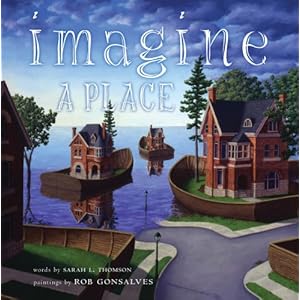
Imagine a Place

I chose this picture book to read because of the illustrations in this book. The illustrations are phenomenal and really would get students to think. There are so many other crafts of writing that can be taught through this picture book. In this book, the phrase, “Imagine a place,” is repeated to draw attention and importance to what was going to be said next. It also uses descriptive language that describes the pictures. This is an important concept for students to get a better understanding on. Lastly, I really like this picture book because it can be used for any grades in elementary school. Being a future teacher, I would love to see how older and younger elementary students interpret this picture book differently.

For a lesson with students, I would start by placing one of these illustrations on the whiteboard or SMART board in the front of the class. I would say nothing except repeat what my students say about the illustration. When looking at any of these illustrations in the book, there are a multitude of things going on in each picture. As a class, I would want them to decide what they think is going on in the illustration. This will be done two more times. Once the students have completed this activity, I will read the book to the students. I would ask my students if they see any similarities between the pictures and words that go along with it. When the read aloud is complete, I will give each of my students a piece of paper. In their writer’s notebook they will draft and complete this sentence, “Imagine a place….” Then they will take the piece of paper and draw a picture that goes along with their sentence. This will turn into the class’s very own “Imagine a place….” book. This book will be placed in our classroom library so all the students can take a turn in reading.

Imagine a Place
Author: Sarah L. Thomson
Illustrator: Rob Gonsalves
Year Published: 2008 

Monday, November 3, 2014

Gabby & Gator

This graphic novel told the story of a friendship that emerges between a little girl named Gabby and an alligator named Gator. Gabby was called a freak by everyone she met. She did not talk to anyone and did not have any friends. Gabby had weird hobbies like recycling and playing the tuba. She just did not fit in! Gator, on the other hand, was an alligator that lived in the sewer. He was flushed down the toilet when he was little so he grew to be scared of water. Gator had a little problem. When he was hungry, he would leave the sewer and eat people’s pets in the neighborhood. One day, a bully was picking on Gabby. Gator say this and decided that he could help. He scared the bully away and from then on Gabby and him became the best of friends. They began to do everything together: play the tuba, draw, and collect recyclables. Gator and Gabby really got along until the bully got scared by Gator again. The bully decided to tell animal control that Gator had eaten a little girl. So Floyd went on a mission to capture Gator. Meanwhile, the bully told Gabby that he told animal control about the monster gator that ate little girls. Gabby, tired of being picked on, stood up for herself before going to animal control to save Gator. Gator and Gabby escaped from Floyd. From then on, Gator and Gabby took on the world together: Gabby found someone who accepted her for who she is and Gator found someone to help him get over his fear of water and help his control his eating problems.

I really enjoyed this graphic novel. This was the first graphic novel I have ever read and I thought that it was funny and entertaining. I can see why this genre is becoming more and more popular with students. The visuals combined with the language and dialogue make the book easy to read. This particular novel is one that I can see relating to students of all elementary ages. Children of all ages struggle with fitting in and finding a friend that best fits them. This story talks about bullies and this struggle of always finding someone who accepts you. It also teaches students how to stand up for yourself. Something I really liked about this book is how realistic it is for a cartoon. There are a lot of different themes that make the story realistic and a good book to learn lessons from. I also think this would be a good novel to look at about judging people by what they look like. Even though Gator seemed scary and was an alligator, Gabby did not let that bother her and she got to know Gator for who he was. After reading this novel, I can also see how graphic novels can help ESL/ELL students. The novels are a quick read and because of the visuals, the students do not have to focus as much on the words and sentences. They can develop their own meaning of the story from the visuals. I am definitely going to have a graphic novel section in my own classroom library one day and I really want to read more of them. They will become a part of my classroom and be used for my students who struggle with reading or dislike reading. Graphic novels are a great addition to the classroom and I now see why they are so popular among students of all ages today.

Gabby & Gator
Author: James Burks
Year Published: 2010