Friday, October 3, 2014

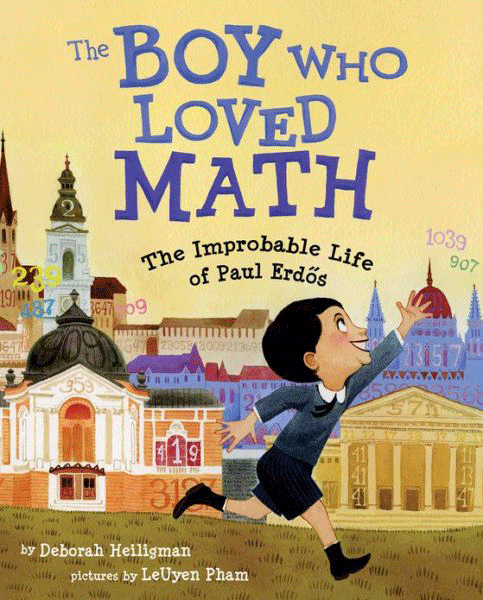
The Boy Who Loved Math: The Improbable Life of Paul Erdos

This informational picture book told the story of Paul Erdos, a boy who loved math and grew up to become one of the greatest mathematicians in the world. Paul was a typical child who hated school and hated rules. He wanted to do his own thing and do it his way. Paul was content staying at home with his mom and Fraulein, his nanny. He could do math all day and every day then. When he got a little older, he invented his own way of life. Paul traveled the world sharing his knowledge of math and numbers. As he got older, the more his life became filled with not only math, but with friendships he had made because of it. Eventually, he passed away while he was doing math at a meeting. Paul Erdos was a man of numbers and one that made an impact on every one he met.

A common theme that I have realized with informational picture books is that if the story is about a person, they start out with them as a child. I think this is very important for children to see. It gives them a way to connect with the person immediately. I like how this book highlights numbers and math specifics. It discusses Erdos numbers, prime numbers, infinity, negative numbers, and formulas. For some of them it explains how to find the answer while others it gives examples. The last page in the entire book is my favorite. It has buildings and children from everywhere in the world surrounding Paul. Each building is made up of numbers and the children even have numbers on them. It supports a multicultural classroom and this book could be used to slide into many different topics. Students could be given one of the buildings from the last page and do research about what it is and where it is from. They can then find out how math was applied to it in order to be built. This book portrays math in a way that is fun and applicable to every student. 

The Boy Who Loved Math: The Improbable Life of Paul Erdos
Author: Deborah Heiligman
Illustrator: LeUyen Pham
Year Published: 2013

Different Like Coco

This informational picture book tells the story of Coco Chanel and her life before becoming a huge fashion success. Its starts out explaining her childhood and how difficult it was. She was orphaned at the age of twelve and had to live in a convent with nuns. This is where Coco learned how to sew. She would sew herself ribbons for her hair and make little dolls out of scraps of fabric. Coco was treated like a second class citizen because of her economical state but yet she did not let this bother her. She studied the way the “rich girls” acted at Notre Dame and began to master their manners and confidence. Coco went and worked for a tailoring shop when she finished at Notre Dame. She realized that she was never going to look like the ladies of the high society, so instead of trying to fit in- she remained true to herself. Coco was different. She was skinnier than everyone else. Coco did not want to wear the same clothes as everyone else. She began to make her own. One day, she met a man named Boy Capel and he bought her a small shop so she could sell her clothing. For years, she grew her business. As the tables turned in society, the conception of what women were to look like changed. Everyone wanted to be Coco and this was all because she remained true to herself and stayed different.

This story is truly an inspiration for all my future female students. I think this informational text picture book portrays both Coco’s personal life and her fashion life in a way that helps remind students that they must be true to themselves. Coco was different from everyone and instead of changing herself, she embraced her differences. She did not let anything stop her or get in her way of letting her achieve her goals of living a life in the higher society filled with her passion for fashion. I would want all my students to reflect on this story and think about something that they are so passionate about that they would stop at nothing to be able to accomplish it. As they are reflecting, I would want them to think about some of the obstacles that they may have to face along the way. The students would write about how they may overcome these barriers of life. Lastly, I would want my students to write about what makes them different from everyone else. We could create a published book called “Different Like Us.” This has become one of my favorite picture books. I never thought I would enjoy informational picture books this much! 

Different Like Coco
Author: Elizabeth Matthews
Year Published: 2007

Thursday, October 2, 2014

Balloons Over Broadway: The True Story of the Puppeteer of Macy's Parade

“Every little movement has a meaning of its own.” This quote was said by Tony Sarg, the main character of the story. The book told the story of Tony and how he went from being a boy with a dream of becoming a marionette man to a genius who created the Macy’s Day Parade. Tony was born to bring happiness in the world. When he was younger, he lived in London and created puppets for the boys and girls who lived there. As soon as Tony moved to New York City, the Tony Sarg Marionettes performed on Broadway and soon were in the “Wondertown Windows” of the Macy’s stores. On Thanksgiving Day in 1924, Macy’s had their first parade to honor their employees. Tony was hired to create the floats and costumes for everyone. He soon realized that he wanted to create balloons so everyone could see the parade. So he figured a plan of how to create upside down marionettes for the parade. It was an instant success and to this day we still celebrate Thanksgiving Day mornings by turning on the television or going to New York City to see this very special parade.

This has got to be one of my favorite picture books of all time. I absolutely fell in love with not only the way the book was worded but with the pictures as well. It turned a story that had a lot of information into a fascinating story about a boy with a dream and who now makes everyone so happy on Thanksgiving Day. I never had realized that the Thanksgiving Day parade originally was created to honor the immigrants who worked in Macy’s. It provides students with a new perspective of immigrants that we normally do not see or think about when we think back to this time period. I would want to use this book around Thanksgiving time so my students could watch the Macy's Thanksgiving Day Parade with their family. This novel makes this story come to life for the audience and children would really enjoy it. An activity that would go great along with this picture book would be to have the students come up with their own float or balloon idea that they would want to be included in the parade. The students could work in groups to create smaller versions of their floats and draw sketches of what their balloon would look like. Lastly, it provides the audience with information in a way that you do not even know you are learning about a person and their actual life. It took me a second at the end to process everything I had just learned. Truly an extraordinary picture book!

Balloons Over Broadway: The True Story of the Puppeteer of Macy's Parade
Author: Melissa Sweet
Year Published: 2011

Wednesday, October 1, 2014

The Unfinished Angel

This novel was about an angel, named Angel, and a little girl named Zola. Angel is not used to people being able to see her. But Zola is something special. She has been able to see Angels ever since her little brother, Jake, was born early and almost died. Zola finds out that there are homeless children living in a barn without families or food. She decides that she must do something, but knows she cannot do it alone. Zola begs Angel to help her find a place for the children to live so Zola can bring them food. Angel lets the children move into her tower and they work together to take care of them. Zola and Angel fight for justice for the children and they end up being successful. The children are able to stay at the new school that Zola’s dad built and receive a great education with a new, loving family.

I chose to read this novel because as a child, I read every Sharon Creech book published. I was obsessed with her as an author. When I came upon this book in the library, I was shocked to see that she had come out with another novel. To be honest, I was a little disappointed with this novel. After remembering how much her stories made an impact in my own life when I was younger, I was hoping this book would do the same. But instead, this book provoked me to question a lot. It discussed some of the harder topics that you could discuss in a classroom like life after death, homelessness, child hunger, and family issues. These social justice issues are brought into a perspective that children can think about and reflect on. Even though this was not one of my favorite Sharon Creech books, I feel that this book was not supposed to be like the rest of her books. I think she wanted to push the limits of what she talked about and wanted to alert her audience of the social injustices that surround us every day. 

The Unfinished Angel
Author: Sharon Creech
Year Published: 2009

Wednesday, September 24, 2014

King Puck

This fantasy picture book told the story of a goat named Finny and his lonely owner Seamus. They lived together in the mountains of Ireland all by themselves. At night, Seamus would read Finny the stories of Finn MacCool. Finny loved hearing this story and hoped that one day he would be wise like Finn MacCool too. Seamus grew tired of the books but he grew more tired of being alone and having no one to talk to. The fairies that lived close by cast a spell on Finny and he was able to talk to the next morning! This made Seamus and Finny very happy. But the fairies were not done with their surprise. The fairies invited Seamus and Finny to the King Puck Festival. This festival crowned the best goat to be king for the day. When they got to Killorglin, the judges were not impressed by Finny. He was just an ordinary looking goat. Desperate for a second chance, Finny asked the judges for a second chance so he could recite the tale of Finn MacCool. The judges were shocked when Finny opened his mouth and he talked. After he recited the tale, the judges awarded Finny with being king for the day. When they asked Finny what he wanted as king, he wished for new books from the library each week. In the end, everyone lived happily ever after.

I really enjoyed this picture book. First of all, I love how this story is culturally diverse. It takes place in Ireland and reflects on one of their most important festivals of all year. Doing some research, I was surprised to read all about the King Puck Festival. This would be a great story to read around St. Patrick’s Day and also a great book to explain their culture. Another point that I love from the story explains the importance of books and knowledge that is learned from them. Finny appreciated that books made you wiser. I would use this book for a student who may be struggling to find a reason or a point of why he or she needs to learn how to read. Lastly, I think the moral of the story is also something that needs to be taught to students. Finny might have looked like an ordinary goat and been nothing too special on the outside, but he had a talent that no one else had: he could talk. This is important to teach students because they should not judge someone just because of what they look like on the outside. It is an important lesson for students to learn and this book is a great way to explain this life lesson. This picture book will definitely be in my classroom library and one I use for lessons in the future. 

King Puck
Author: Michael Garland
Year Published: 2007

Baby Brains and RoboMom


This picture book told the story of Baby Brains who is the smartest baby in the universe. He was unlike other babies who just cried and slept. Baby Brains was very clever and enjoyed working on a computer, doing chemistry experiments, and especially designing new inventions. He created a fully motorized stroller and a cradle that rocked itself. Baby Brains realized that his parents were still very tired. So he created RoboMom! RoboMom started to do everything from ironing to tucking Baby Brains into bed. But then RoboMom began to stop working. It started to mess up what it was doing. RoboMom even washed Baby Brains in the kitchen sink and hung him outside on a line to dry. Baby Brains was very sad and screamed for his mom. RoboMom began to smoke and then it exploded! Baby Brains and his parents started to work together around the house. They all liked this very much but Baby Brains decided that they could use a little help, so he created a smaller RoboMom 2.

This science fiction picture book could be used in the classroom to have students create their own thoughts about technology. I would love to do a writing activity were the students will write about things that they do not like doing, for example homework. Then I would like to see them write about what they would create so they wouldn’t have to do homework anymore. The students would have to draw or make a model of their creation. This book could help to lead students to do research about new technology that is being created to help around the house. I also would want to hear students opinions about technology and if they really want robots to do things for them. It would be interesting for them to reflect on what they think that will do to our world in the future. I think this book would be a great addition to a classroom library and really could be used to generate students' thoughts about what our future world will look like. 

Baby Brains and RoboMom
Author: Simon James
Year Published: 2007

Baloney (Henry P.)

This science fiction picture book tells the story of a little alien named Henry P. Baloney. Henry was late to class and was given the punishment of lifelong detention unless he could come up with a very good and believable excuse. Henry began telling the story of how he lost his pencil and was on his way to school in a truck but he got stuck in the middle of a rocket launch pad. He got stuck in a rocket and tried to use the controllers to bring him to school but instead he ended up on the wrong planet. Henry almost got eaten on the new planet so he used calculations and diagrams to change their minds. He got crowned king of the planet! But instead of saying thank you, Henry accidentally called them “doofbrain.” They planned on sending Henry back to school in a flying saucer, but they wanted to destroy both of them. So Henry used his trusty pencil and erased the door lock and fell out of the flying saucer. He almost splattered on the ground when he realized that falling bodies obey the law of gravity. Henry did not know the law of gravity so he decided it was time to come to school. Miss Bugscuffle, Henry’s teacher, was annoyed and told Henry that his story was unbelievable. But Henry lucked out because the assignment of the day was to write a tale tall. Henry told Miss Bugscuffle that he would write his assignment but he had lost his pencil again.

This was a very cute, action-packed story. I think students would love the story. Throughout the book, Henry uses many different Earth languages to tell his story. There is a decoder or glossary in the back of the book with the twenty words used from other languages. What is interesting is that these words are kind of close to the English language. For example, school is referred to as szkola throughout the story or razzo which means rocket. As a future teacher, I would first read the story using the words in the other language. I would want my students to pick up that there were words that were not English in the book. Then I would read it again allowing the students to guess what they though the words were. They could use the pictures to try to guess what the words are. Lastly, I would read the story again to them using the English words. This would open my students’ eyes to the fact that there are other languages in the world. I would want to do a lesson where we could locate where in the world these languages are spoken. I also could use this book to explain to my students what a tall tale is. They could write their own tall tales of why they might have been late for school or why they didn't do their homework. I also think the way the pictures were illustrated throughout the story was very unique. It reminds me of a cartoon in a way. This book explains perfectly what a science fiction picture book is all about. I will definitely be using this book in my classroom one day. 

Baloney (Henry P.)
Author: Jon Scieszka
Illustrations by: Lane Smith
Year Published: 2005