Saturday, November 29, 2014

Chicken Little

Chicken Little told the story of a little chicken who had an acorn fall on her head. She thought that the sky was falling so she went to each of her friends to tell them the news. All of her friends went with her to tell the king this terrible news. On the way there, they ran into a fox that tried to trick them into going into his den so he could eat them. One of Chicken Little’s friends realized this and they ran away. Finally they got to the king, to only be told that Chicken Little was wrong. He showed them the acorn he found on her head and told them that the sky was not falling. Everyone was relieved and lived happily ever after.  

I chose to read Chicken Little because it was one of the featured stories on the main screen. I was quite disappointed with this story. It was extremely short and not very engaging for students to read or be read to. This story came in a few ways. You could read it by yourself or have it read to you. I think these eBooks could help ELL and ESL students work on their fluency. It can give them someone to listen to and most of the words are very basic which would help their confidence to grow.
Chicken Little
Author: Amy Kraft
Illustrator: Violeta Dabija
www.speakaboos.com
EBook 3 

The Haunted Party

In www.speakaboos.com a student can choose from many different genres that they would like to hear a story from. They include: fairytales, nursery rhymes, scary stories, adventure stories, sport stories, food stories, sing along song stories, animal stories, ABC’s and 123 stories, and things that go stories. Children can even chose from some of their favorite characters from these stories to read them another story. They even have a dragon next to what looks to be a television screen showing new stories and featured stories that go along with holidays, etc. This story was one from scary stories. It would be good for younger elementary students, like kindergarteners and first graders. In this eBook, it tells the story of different ghosts, goblins, ghouls, witches, etc. going up in numbers (and then back down) and what they are doing at this haunted party. This eBook has repetition and rhymes throughout the entire story.

I really liked this eBook. It did a good job of including different writing crafts, like rhyming and repetition. Also, I liked how it was very diverse. There is a part in the story that shows ten children trick or treating and it does a wonderful job of showing diversity. The graphics in this eBook are much better than the last. If I were to teach younger elementary students, I would love to use this eBook in my class. I would like for my students to be able to use eBooks as an option in my future classroom library. It is important for students to be able to learn how to read from a computer or iPad screen. I could use eBooks and using the computer/iPad as a reward system for students. If they read five books, they can earn the privilege to going onto the computer or iPad to read an eBook. 

The Haunted Party
www.speakaboos.com
EBook 2

The Little Mermaid

This eBook told the story of The Little Mermaid with a twist. I listened to this eBook from the website: Speakaboos.com. Never having seen an eBook, I wanted to choose a story that I am very familiar with. Some of the story held the same lines as The Little Mermaid, the book, and the movie. I was a little disappointed though when the rest of the story was not very similar to any of other Little Mermaid stories that I have heard before. The mermaid was taken care of by her grandmother and was allowed to go to the surface when she was fifteen years old. She was supposed to die once the prince had decided to marry another princess but instead the Earth fairies saved her life because of her true selflessness to the prince. The little mermaid became a mermaid again and lived with her father, sisters, and grandmother in true happiness.

I really don’t know how I felt about this eBook. In my opinion, I like how the eBooks are engaging and appealing to children. The words are on the screen and light up when the narrator or character say that word. But there are some things that I did not like. I did not like how the story was changed from the original Little Mermaid. Also, I did not like how there were misspellings and grammar errors throughout the story. The graphics were not very good, in my opinion, either. As a future teacher, if I were to use eBooks in my classroom, I would want to review them first to see if there are appropriate and free of any grammatical errors. Otherwise, I think using eBook every once in a while is good for students. 

The Little Mermaid 
www.speakaboos.com 
EBook 1

Friday, November 21, 2014

Butterfly Eyes and Other Secrets of the Meadow

This book holds a collection of poems together that describe life in a meadow. There are poems that tell the story of each animal that lives in a meadow. Some describe the plants, flowers, sun, or rain. There are even some poems that explain the life cycle or how some animals interact with one another. I really enjoyed the poems but the illustrations are a little overwhelming at times. One of the best features about this text is that in this book there are over five different kinds of poems: shape poems, ballads, haikus, rhyming poems, etc.

This book was not one of my most favorite poetry picture books. I did really enjoy the poems, but the illustrations are distracting. This book would definitely have to be used with upper elementary students because there are some words in the book that would be hard for younger students to understand. There is even a glossary in the back of the book that I had to use to understand what some of the poems were talking about. I would use this picture book when future students are learning about different types of poetry because this book does do a nice job at showcasing them. Students could even come up with their own after seeing the poems in this book.

Butterfly Eyes and Other Secrets of the Meadow
Author: Joyce Sidman
Illustrator: Beth Krommes
Year Published: 2006 

Thursday, November 20, 2014

Follow, Follow: A Book of Reverso Poems

In this book, classic fairytales are told with a new twist. When reading this book, the page is split in half. On one side, it reads a poem and on the other side it shows the same poem but as if you were reading it reversed (bottom to top). Each of these poems are told from a new perspective when they are reversed. For example, there is a poem named “Ready, Set, Go!.” This poem is a rendition of the story the Hare and the Tortoise. One side of the page tells the story of the rabbit and the other tells the story from the tortoise, using the same exact words. The illustrations even go along with every story perfectly!

I fell in love with this book and the collection of poems inside. Younger elementary students would love to hear the stories inside and the words are switched around to tell the same story from a different point of view. If I were to use this book for fourth and fifth grades, I would want students to work in partners to create their own reverso. Before reading this picture book of poems, I had never known reverso poems existed. This is something that I liked about the book. It introduced poems in a new light for students. They are not traditional rhyming poems but instead they look very different. These poems are very creative and unique to the world of poetry. But the crafts of writing it takes to create these poems are something magical. The thought behind each of these poems help students to use higher levels of thinking and look at poetry in a new light. This collection of poems is truly a great picture book and one that I will have in my classroom! I also want to look at the book: Mirror, Mirror. It is a companion book to this one.

Follow, Follow: A Book of Reverso Poems
Author: Marilyn Singer
Illustrator: Josee Masse
Year Published: 2013

A Whiff of Pine, a Hint of Skunk: A Forest of Poems

This book was a collection of poems that explored the animals of the forests and the seasons. These entertaining poems would certainly be a delight for any students. In this collection of poems, the animals come off as being very quirky and talk about things they think or dream about.

I definitely think this book would be a hit with students of all ages. Poetry is a big part of school now, so I feel that either reading this book to students or keeping it in a classroom library is a great option. Younger elementary students would love to have been read this book. It would give them an opportunity for their imagination to soar. Older elementary students could analyze these poems and look at their features. Students can look at the rhyming scheme, the stanzas, verses, etc. Upper elementary students will even be able to appreciate the poems more because they will understand some of the jokes that the animals make throughout the poems. They will see one of the purposes of poems which is to entertain. Students will love this book and it will be a good poetry book to have in my future classroom.

A Whiff of Pine, a Hint of Skunk
Author: Deborah Ruddell
Illustrator: Joan Rankin
Year Published: 2009 

Inside Out and Back Again

Inside Out & Back Again is a book of poems that is told by a young girl named Ha. Ha is a ten year old girl who is grew up in Saigon in Vietnam but had to leave because the Vietnam War was affecting her town. The family was forced to flee and set sail on a ship to America. Her father is still missing but yet the family gathers the courage to move to another world to keep them safe and allow them to continue having opportunities. The family faces many struggles with their move like, language barriers and culture shock. This is a fantastic story about a girl and her family dealing with enormous changes but yet learning how to survive. 

This story would be great for upper elementary students, middle school student, or even high school aged students. Many students would be able to connect with this story, especially students who have moved from another country or even another state. Also students would be able to connect with the hard times the family faces, which are similar to challenges that families face. I would want my students to become educated in the Vietnamese culture before reading this book. There were many cultural ideas and traditions that I was unfamiliar with when reading this book. I think I would have been able to understand and connect better with the book if I understood some of the terms. Also I would use this book to help students develop a better understanding of poetry. Students can learn many things from this book and I definitely want to have it in my classroom one day.

Inside Out and Back Again
Author: Thanhha Lai
Year Published: 2011 

Tuesday, November 11, 2014

Hana Hashimoto, Sixth Violin

Hana, who has just been playing the violin for a few weeks, tells her brothers that she is going to be a part of the school’s talent show. Her brothers nearly fall out of a tree they laugh so hard. Instead of letting this discourage Hana, she practices day and night to everyone or no one. She wanted to live up to her grandfather’s legacy when he was the Second Violin in the symphony orchestra in Kyoto. Ojiichan even had played in front of the Imperial Family. When the moment finally came for Hana to perform, she began dizzy and wished she had never signed up to be a part of the talent show. But before she gave up, she remembered words her grandfather used to tell her, “Do your best,” and Hana did just that. She played sounds that were familiar to her and did a wonderful job. Her brothers even wanted an encore after the show at home. Hana knew she had a lot of work still to do to be as good as her Ojiichan but she was still proud of all she accomplished.

I thought this picture book was a great multicultural book. It was very interesting to learn about Hana’s grandfather and all that he had accomplished. I liked how the book included Japanese words to make the culture that the audience was experiencing come to life. It also had a great moral of the story. Once again, it taught students to try their best and how practice will make perfect. I feel that students can relate to this because this theory can relate to playing instruments, sports, etc. Loved this diverse picture book and definitely will have it in my future classroom.

Hana Hashimoto, Sixth Violin
Author: Chieri Uegaki
Illustrator: Qin Leng
Year Published: 2014

Maxwell's Mountain

This cute children’s picture book reminds students that whatever they put their mind to, they can accomplish it. Maxwell’s Mountain is about a young boy named Maxwell that is bored playing on the same old playground. He wants to climb the mountain where the ‘big kids’ play. His parents both agree that he is too small and not old enough to climb the mountain in the park. They tell him that only a true outdoorsman could climb the mountain. This gives Maxwell an idea. He decides to find out everything he needs to know about what it means to be a good outdoorsman. Maxwell begins by getting books from the library and researching about how to be a good outdoorsman and how to climb mountains. Then he made a list of things he had to do. Maxwell began to train for climbing the mountain by climbing the staircase four times every day. Next, he made a map of the mountain marking out the trail. Lastly, he put together a backpack with a first aid kit and other items he must need in order to be successful climbing the mountain. All prepared, Maxwell begins his journey the next day. During his climb, he gets lost! But he soon remembers what his mother said about good outdoorsman. Maxwell uses his head and finds the trail again. He makes it to the tippy top and gets rewarded with a view of the city and the ocean.

Maxwell’s story is very similar to lots of young elementary children’s stories. All kids face something that they are “too small” for or “not old enough”. Kids also face many challenges that they are going to have to do lots of things in order to accomplish it, like Maxwell. Because of this, students can relate to this story. They will be able to make connections between their lives and Maxwell’s life. If I was teaching younger elementary students, I would use this book to help students not only set goals, but also set a plan of how they will accomplish that goal. This is an important life lesson to teach students and this book exemplifies this perfectly. I also think that boys would really enjoy this book- so I would definitely want to include this in my classroom library. Lastly, the art work in this picture book is really unique. I love how you have to flip the book to see the entire size of the mountain. It gives the students a different perspective, which I would like them to do in their own artwork. Definitely a cute picture book that will be added to my classroom library one day!

Maxwell's Mountain
Author: Shari Becker
Illustrator: Nicole Wong
Year Published: 2006 

Show Way


This book tells the story of slavery. It talks about the hardships and struggles female slaves faced. The book tells the story through the lines of generations. It also explained how these ladies would sew squares to make a quilt to resemble how they got through slavery. The illustrations are quite colorful and the quilt pieces make up the background of all the pictures. This text is full circle meaning it starts and ends the same way. It also has a lot of other pieces of figurative language, like repetition and metaphors. It was very cool to have read a novel (Feathers) written by Jacqueline Woodson and then a picture book by her. It was interesting to see the similarities in her writing between the two. I found that out that I really enjoy her writing and the use of symbolism.

I would love to use this book in my classroom one day. I feel that it would be a good book to tackle the issue of diversity and bring up “hard to talk” about topics. It really focuses on the culture of African Americans and also looks at it from women’s perspectives which is very rare. If I were to use this book in my class, I would want my students to create their own square for a class quilt. They can devise a plan of how they will make it through that grade, their goals, and their dreams. It would be a great class collaboration project that I feel students would really enjoy. The artwork in this picture book brings the words to life and really showcases the African American culture. I feel like my students would really enjoy this book and the perspective of slavery that it portrays.

Show Way
Author: Jacqueline Woodson
Illustrator: Hudson Talbott
Year Published: 2005

Friday, November 7, 2014

Magritte's Marvelous Hat

This book told the story of Magritte who was a painter. One day, he went for a stroll and saw a marvelous hat in a window of a store. This was a special hat, one that floated above his head. His new hat made painting very easy and he began painting his best pictures ever. Magritte’s hat liked to play games with him and would pretend to fly away. But Magritte continued to paint day and night because of how good they were and he began to forget about his hat. Making the hat upset, it took off and hid from Magritte. This gave him an idea! To get his hat back, he must play his favorite game- which was hide and seek. Finally Magritte’s hat came back and sat on his head, making him float in the sky. But every afternoon, would paint and they would become his best picture yet.

This picture book is probably one of the coolest picture books I have ever seen and will definitely be in my classroom library. I think this books is good for elementary grades kindergarten through fourth. Picking up this book, you wouldn’t expect much from it. The title is not really interesting and the illustration is not spectacular. But when you open this book, there are surprises along the way. This book would be really good to use as an example for your students to never judge a book by its cover- literally. Some of the pages in the book are see through! They have illustrations that go with the one page and when you turn the page the illustrations correlate with the words on the next page. It is one of the most creative and unique picture books I have ever seen. This book is a must to show my future students.

Magritte's Marvelous Hat
Author: D. B. Johnson
Year Published: 2012 

Wednesday, November 5, 2014

You Read to Me, I'll Read to You Very Short Fables to Read Together

This book is comprised of very short fables to read together. It has two different reading parts, color-coordinated and organized in such a way that makes it easy to tell the difference between the parts. At the end of each fable, the moral of the story is written in pink, just like the title of each fable. Each fable is comprised of two-three reading parts and pictures to explain the fable as you go. I really like how in this book it encourages students to read to someone else. The fables consisting of rhyming and easy sight words that are good for beginning readers. This will help the readers to build up their confidence and create a safe place for students to want to read aloud. The last thing I really like about this book is how the book explains how it should be read and where the ideas from this book came from. Students find this information interesting and it can help them to gain a better understanding of why the author wrote what they did. Once again, this became one of my new favorite book and it will definitely be a hit among my future students.

As a student that once struggled with reading, I would have loved to have seen a book like this published when I was younger. I think it is very creative and a good way to get students to work on reading aloud without putting any sorts of pressure on them. I would want to use this book in lower elementary grades. In my opinion, I feel that it can be used for English Language Learners (ELL) and English Second Language (ESL) students. Since the structure, format, and illustrations of the book are easy to understand, ESL and ELL students are sure to love and benefit from this book. The words are simpler for them and all students love a book that has rhyme and rhythm to it. I would want groups of two to come and read a different fable to me with a partner. This will help the students to work on their collaboration with one another and get them to practice their fluency when reading aloud. Lastly, this book is a great book to have at home. Parents, older siblings, and other guardians can easily read a fable a night with their student to help them work on their reading skills. It promotes unity and more parent/guardian involvement with students' schooling. I really love this book!

You Read to Me, I'll Read to You     Very Short Fables to Read Together
Author: Mary Ann Hoberman
Illustrator: Michael Emberley
Year Published: 2010

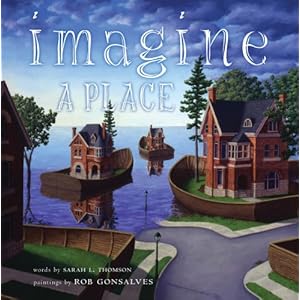
Imagine a Place

I chose this picture book to read because of the illustrations in this book. The illustrations are phenomenal and really would get students to think. There are so many other crafts of writing that can be taught through this picture book. In this book, the phrase, “Imagine a place,” is repeated to draw attention and importance to what was going to be said next. It also uses descriptive language that describes the pictures. This is an important concept for students to get a better understanding on. Lastly, I really like this picture book because it can be used for any grades in elementary school. Being a future teacher, I would love to see how older and younger elementary students interpret this picture book differently.

For a lesson with students, I would start by placing one of these illustrations on the whiteboard or SMART board in the front of the class. I would say nothing except repeat what my students say about the illustration. When looking at any of these illustrations in the book, there are a multitude of things going on in each picture. As a class, I would want them to decide what they think is going on in the illustration. This will be done two more times. Once the students have completed this activity, I will read the book to the students. I would ask my students if they see any similarities between the pictures and words that go along with it. When the read aloud is complete, I will give each of my students a piece of paper. In their writer’s notebook they will draft and complete this sentence, “Imagine a place….” Then they will take the piece of paper and draw a picture that goes along with their sentence. This will turn into the class’s very own “Imagine a place….” book. This book will be placed in our classroom library so all the students can take a turn in reading.

Imagine a Place
Author: Sarah L. Thomson
Illustrator: Rob Gonsalves
Year Published: 2008 

Monday, November 3, 2014

Gabby & Gator

This graphic novel told the story of a friendship that emerges between a little girl named Gabby and an alligator named Gator. Gabby was called a freak by everyone she met. She did not talk to anyone and did not have any friends. Gabby had weird hobbies like recycling and playing the tuba. She just did not fit in! Gator, on the other hand, was an alligator that lived in the sewer. He was flushed down the toilet when he was little so he grew to be scared of water. Gator had a little problem. When he was hungry, he would leave the sewer and eat people’s pets in the neighborhood. One day, a bully was picking on Gabby. Gator say this and decided that he could help. He scared the bully away and from then on Gabby and him became the best of friends. They began to do everything together: play the tuba, draw, and collect recyclables. Gator and Gabby really got along until the bully got scared by Gator again. The bully decided to tell animal control that Gator had eaten a little girl. So Floyd went on a mission to capture Gator. Meanwhile, the bully told Gabby that he told animal control about the monster gator that ate little girls. Gabby, tired of being picked on, stood up for herself before going to animal control to save Gator. Gator and Gabby escaped from Floyd. From then on, Gator and Gabby took on the world together: Gabby found someone who accepted her for who she is and Gator found someone to help him get over his fear of water and help his control his eating problems.

I really enjoyed this graphic novel. This was the first graphic novel I have ever read and I thought that it was funny and entertaining. I can see why this genre is becoming more and more popular with students. The visuals combined with the language and dialogue make the book easy to read. This particular novel is one that I can see relating to students of all elementary ages. Children of all ages struggle with fitting in and finding a friend that best fits them. This story talks about bullies and this struggle of always finding someone who accepts you. It also teaches students how to stand up for yourself. Something I really liked about this book is how realistic it is for a cartoon. There are a lot of different themes that make the story realistic and a good book to learn lessons from. I also think this would be a good novel to look at about judging people by what they look like. Even though Gator seemed scary and was an alligator, Gabby did not let that bother her and she got to know Gator for who he was. After reading this novel, I can also see how graphic novels can help ESL/ELL students. The novels are a quick read and because of the visuals, the students do not have to focus as much on the words and sentences. They can develop their own meaning of the story from the visuals. I am definitely going to have a graphic novel section in my own classroom library one day and I really want to read more of them. They will become a part of my classroom and be used for my students who struggle with reading or dislike reading. Graphic novels are a great addition to the classroom and I now see why they are so popular among students of all ages today.

Gabby & Gator
Author: James Burks
Year Published: 2010

Friday, October 31, 2014

Just A Second

Just a Second is my favorite Steve Jenkins book. It talks about what happens to things in a second, minute, hour, day, month, and year. This information picture book also discusses what happens extremely quickly and what takes and extremely long time. One of my favorite parts about the book is that in the back of the book, it includes different graphs that organizes things like the history of the universe or the life span of plants and animals. Another feature that I really like about this book it that it continues some of the facts and information through a day, month, and year and explains what happens along the way. This is very interesting and intriguing book that puts time into perspective for students. It gives the students a different way to look at time and put the rest of the world around them into a new perspective. 

For this book, I would want my students to do an activity that is called analyzing an informational text using a visual profile. In this activity, it has the students rate the nine elements of informational text and how prevalent or not it is in the book. This makes students think past the words and the pictures and think more about the features of the text. Another activity that I would like for my students to do using this book is to track something (anything they would like) on what happens to it in a second, minute, hour, day, month, and year. An example would be the students could look up what happens to trash when we do not dispose of it properly in a second all the way to a year or whenever it decomposes. It will give the students a better understanding of time. This informational picture book should be used with older elementary students because it has a lot of complex information that would be too hard for younger elementary students to understand. Overall, I really enjoyed the book and I think it would be a great addition to any classroom.

Just a Second
Author: Steve Jenkins
Year Published: 2011

What Do You Do With A Tail Like This?

This Caldecott Honor Book is one of a kind. It first gives a part of animals like their noses, ears, tails, eyes, mouths, or feet and then on the next page describes what they use them for. For example, on one of the first pages it shows an elephant’s trunk. It asks the question, “What do you do with a nose like that?” On the next page, it shows the elephant and it using his trunk to give itself a bath. It does this for noses, ears, tails, eyes, mouths, and feet. This can show students how animals use their different body parts to defend themselves and help them to survive. For the audience, this informational text provides so much information in a very simple way. It is not complex and allows you to make connections throughout the entire text. In the back of the picture book, the author included information about every animal that was written about. It gives some background information on the animal and more information about the body part and what they use it for.

This is another great book that I would definitely want to use in my classroom one day. I feel that this text could be use with lower and upper elementary students. For lower elementary students, this book could be used when learning about different animals. I think lower elementary students would enjoy this book in a classroom library. The pictures are fantastic in this book and students can learn a lot about different animals too. Steve Jenkins and Robin Page do an excellent job of using animals that are not traditional animals that we think of like a lion, tiger, or bear. They use animals like a platypus, hyena, pelican, or a star-nosed mole. These animals might make the students want to learn more because they are ones that most would not know a lot about. This book would work with upper elementary students because you can use it to look at adaptations of animals. For example, on one of the pages it looks at how the horned lizard squirts blood from its eyes. Students could look up this characteristic of this animal and find out why they do this. This informational text would be a great resource for students to use and can jump-start them into finding more information out. Steve Jenkins and Robin Page do a great job of making information fun and exciting for their audience to read.

What Do You Do With A Tail Like This?
Author: Steve Jenkins
Illustrator: Robin Page
Year Published: 2003 

Move!

This informational text picture book talks about the different ways that animals move. It was a very creative story that went over the different movements of animals like jumping, slithering, waddling, etc. It relates the movements that one animal does to another animal who does the same movement. It asks the audience at the end how do you move, which makes automatically makes the reader think of all the different movement words that were just talked about in the book. Steve Jenkins and Robin Page have a very unique writing and illustrating styles. The pictures of the animals are realistic but still have that cartoonish effect to them. In the back of the picture book, there is an information page that includes every animal written about. It gives information about where the animals are from and interesting facts about them.

This picture book would be perfect in younger elementary grades. Students can learn a lot without it being overwhelming to them. Something that I really liked about the book was there were a few animals that I had not heard of before. I thought this was a good idea because then it provokes children to want to find out more about them. I also liked how the verb or movement that was the main idea for the page was large and the center of focus. The sentences were not traditionally written and continued onto the next page. This could show students another way to be creative when writing their own stories. Using this book with younger elementary students, I would want them to get active with this book. During a read aloud, as I was reading, I would give the students time to figure out a motion that goes along with the movement verb that it used. Then I would reread the picture book having the students do the movement along with it. I think is a very fun piece of literature that is also informational.

Move!
Author: Steve Jenkins
Illustrator: Robin Page
Year Published: 2006

Seedfolks


Being honest, I have never heard of this book before I had read it. I didn’t really know what to think about it. All I knew is that it involved multiple people telling a story about a garden. From the back cover and the title, I wasn’t really excited to read the book. But when I began reading it, I couldn’t put the book down. Each of the thirteen characters told their own story of why they wanted to plant flowers or vegetables in this community garden. It was amazing to read in the story and visualize how a vacant lot could turn into a beautiful and magnificent garden. But besides talking about how the garden changed and grew, the book also focuses on how a diverse part of Cleveland became one because of this garden on Gibb Street. People who would never have talked to one another because they had differences in the way they look or where they are from, started to appreciate one another. 

I would love to use Seedfolks in my classroom one day. This book could be used perfectly to talk about people’s points of views and how to convey that in a story. It also could be used to talk about people’s differences and the diversity that surrounds us. Seedfolks is a great book to help discuss how people don’t get along and how people are judgmental towards each other. I would want to use it as a class book and have the students plant their own garden someone outside of the school. This book has a lot of life lessons that can be learned and it all started with a little girl and a hope to grow lima beans in memory of her dad. An activity that I would like my student to do is write a chapter that could be added to this book describing their life and what flower, plant, or vegetable they would have chosen to plant in the garden. It would be a nice way to bring this book full circle for the students. I thoroughly enjoyed reading this book and definitely plan on using it in my classroom one day.

Seedfolks
Author: Paul Fleischman
Year Published: 2004

Saturday, October 11, 2014

Red Kite Blue Kite

Red Kite Blue Kite is truly a touching story. The relationship between a father and a son cannot be broken even through the toughest of times. Tai Shan, the son, loves to fly his red kite and his father, Baba, would fly a blue one. They would go to the roof of their home and fly them together all the time. But then bad times come and Baba is taken to a labor camp. Tai Shan is sent to live with Granny Wang. Baba comes up with a secret way for him and his son to keep in touch with one another. The same day of the week, at the same time, Tai Shan would fly his red kite and Baba would fly his blue kite. They fly the kites until Baba is freed. Then Baba surprises Tai Shan with hundreds of red and blue kites. The kites were freed just like Baba.

I thought this book was a great picture book. The illustrations and the meaning behind the story were incredible. Once again, this story looked at the Chinese culture. I have noticed that war and dictatorship is a common theme between these stories. This is a part of the culture that I would want to explore more about. This book was inspired by the Cultural Revolution in China and I think it is important for kids to learn what that means. In this book, Granny Wang explains to Tai Shan that the leaders do not like his father because he thinks differently than most. This is a problem that a lot of other cultures deal with as well. This book would be a great stepping stone of finding out more about the Chinese culture. A lesson that I would like to do with my future students is having them create their own way of communicating with someone if they were not allowed to talk or see them. For my upper elementary students, I would want them to find the symbolism of the kites in the story. An enjoyable book and definitely one that I would want to include in my future classroom library.

Red Kite Blue Kite
Author: Ji-li Jiang
Illustrator: Greg Ruth
Year Published: 2013

A New Year's Reunion

A New Year’s Reunion talks about a little girl named Maomao who cannot wait for the Chinese New Year to begin. Not only is she excited for the ceremonies and the delicious sticky rice balls, but her dad gets to come home. He only comes home once a year because he works very far away. The little girl tells the exactly what she and father does to celebrate the New Year and to celebrate being together. When Maomao and her dad are making sticky rice balls, he puts a fortune coin in one of them. Maomao discovers it and the coin is supposed to bring her good fortune for the year. The little girl and her dad celebrate the New Year together watching the dragon dance from the roof of the house and spending quality time with one another. Before her dad leaves for the year again. Maomao gives him the good fortune coin so they can bury it in a sticky rice ball again next year.

I really enjoyed how this picture book describes the Chinese culture and what happens during a Chinese New Year. The book did not only focus on this. It also discusses the sad reality that sometimes families cannot always be together for whatever reason. What is important is that the time you do have together, you enjoy every second of it. I feel that students who have family members in the military or who may work very far away like Maomao’s dad would be able to connect with this story. They would know how it feels to get to see that person for only a short amount of time, maybe once a year. This would be a book that I would want to use in younger elementary grades. It would be a great book that could segway a class into learning more about the Chinese culture and New Year.

A New Year's Reunion
Author: Yu Li-Qiong
Illustrator: Zhu Cheng-Liang
Year Published: 2011